
Set Notation and Symbols

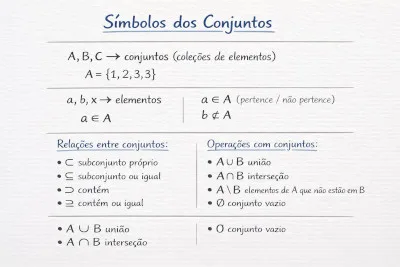
Set notation describes which objects belong to a set and how sets relate to each other. For example, 2 ∈ {1, 2, 3} reads “2 is an element of the set {1, 2, 3}.” The braces enclose the elements. If A = {1, 2} and B = {1, 2, 3}, then A ⊆ B because every element of A is also in B. Explore the Math Symbols guide for the full collection. Tap or click a symbol to copy it.
| Symbol | Name | Description |
|---|---|---|
| ∈ | Is an element of | In 2 ∈ A, the number 2 is an element of A. |
| ∉ | Is not an element of | 5 ∉ B means 5 is outside the set B. |
| ⊂ | Proper subset | Using ⊂ for a proper subset, every element of the first set belongs to the second and the sets differ. For example, {1,2} ⊂ {1,2,3}. |
| ⊆ | Subset | A ⊆ B means every element of A belongs to B. The sets may be equal. |
| ⊃ | Proper superset | ⊃ shows that one set properly contains another, as in {1,2,3} ⊃ {1,2}. |
| ⊇ | Superset | A ⊇ B means A contains every element of B. The sets may be equal. |
| ∪ | Union | The union contains every element in either set. {1,2} ∪ {2,3} = {1,2,3}. |
| ∩ | Intersection | The intersection contains the elements the sets share. {1,2,3} ∩ {2,3,4} = {2,3}. |
| ∅ | Empty set | ∅ is the set with no elements. |
| \ | Set difference | A \ B contains the elements of A that are outside B. |
| Aᶜ | Complement | Aᶜ contains everything in the universal set that is outside A. |
| U | Universal set | U contains all the elements under consideration. |
| ℘(A) | Power set | ℘(A) is the set of all subsets of A. |
| A × B | Cartesian product | A × B contains all ordered pairs with a first element from A and a second element from B. |
| ℕ | Natural numbers | ℕ is the set of natural numbers used for counting. |
| ℤ | Integers | ℤ includes the negative integers, zero, and the positive integers. |
| ℚ | Rational numbers | ℚ contains numbers that can be written as a ratio of integers with a nonzero denominator. |
| ℝ | Real numbers | ℝ includes every point on the number line. |
| ℂ | Complex numbers | ℂ contains numbers with a real part and an imaginary part. |