
Logic Symbols

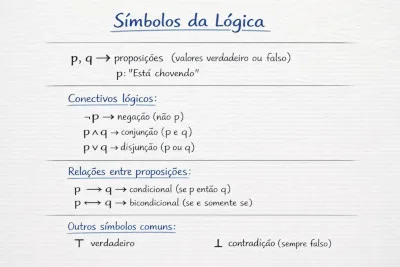
This list explains the symbols most often used in mathematical logic. Explore the Math Symbols guide for the full collection. Tap or click a symbol to copy it.
| Symbol | Name | Description |
|---|---|---|
| ∧ | And | p ∧ q is true only when both p and q are true. |
| ∨ | Or | p ∨ q is true when at least one of p and q is true. |
| ¬ | Not | ¬ reverses a statement’s truth value. If p is true, ¬p is false. |
| → | Implies | p → q means that if p is true, then q must also be true. |
| ↔ | If and only if | p ↔ q is true when p and q have the same truth value. |
| ⊤ | True | ⊤ represents a statement that is always true. |
| ⊥ | False or contradiction | ⊥ denotes falsity or a contradiction that cannot be satisfied. |
| ∀ | For all | In ∀x P(x), the property P must hold for every x in the domain. |
| ∃ | There exists | ∃x P(x) means that at least one x satisfies P. |
| ∄ | There does not exist | ∄ means that no element satisfies the given condition. |
| ⊢ | Derivability | Γ ⊢ φ means φ can be derived from the assumptions in Γ using the proof rules. |
| ⊨ | Logical entailment | ⊨ means the conclusion is true in every model in which the premises are true. |