Algebra Symbols

This list covers the algebra symbols you will see most often, with simple explanations and examples. Explore the Math Symbols guide for the full collection. Tap or click a symbol to copy it.
| Symbol | Name | Description |
|---|---|---|
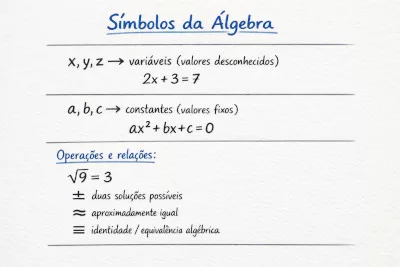
| x | Variable | x can stand for an unknown. In 2x + 3 = 7, the goal is to find x. |
| y | Variable | In a system with two unknowns, y often appears alongside x, as in x + y = 5. |
| z | Variable | z often marks a third unknown, as in x + y + z = 10. |
| a, b, c | Constants | In ax² + bx + c = 0, a, b, and c are fixed while x varies. |
| n | Index or general term | n can indicate a position, a count, or the index of a general term, as in an. |
| ^ | Caret (exponent) | ^ often marks an exponent in plain text. For example, x^2 means x squared. |
| ² | Squared | ² raises a value to the second power. x² means x times x. |
| ³ | Cubed | ³ raises a value to the third power, as in 2³ = 8. |
| √ | Square root | √ reverses squaring on nonnegative numbers. √9 = 3 because 3² = 9. |
| ∛ | Cube root | ∛ gives the number whose cube is the value under the root. ∛8 = 2. |
| ⁿ√ | Nth root | ⁿ√ indicates a root of order n, as in ³√27 = 3. |
| ± | Plus or minus | ± gives two possible signs. For example, solving x² = 25 gives x = ±5. |
| ∓ | Minus or plus | ∓ pairs with ± to indicate opposite signs, as in (a ± b) and (a ∓ b). |
| ∝ | Proportional to | ∝ shows proportionality, as in y ∝ x. |
| ≈ | Approximately equal to | ≈ means the values are close, as in 3.1416 ≈ π. |
| ≡ | Identically equal | ≡ can mark an identity. For example, 2x + 2 ≡ 2(x + 1) for every x. |
| log | Logarithm | log gives the exponent to which a base must be raised to produce a given value. |
| ln | Natural logarithm | ln is the logarithm with base e, often used with exponential equations. |